When people think about workplace safety, they often picture physical hazards: unsafe equipment, slips and falls, chemicals, machinery or physical injuries.
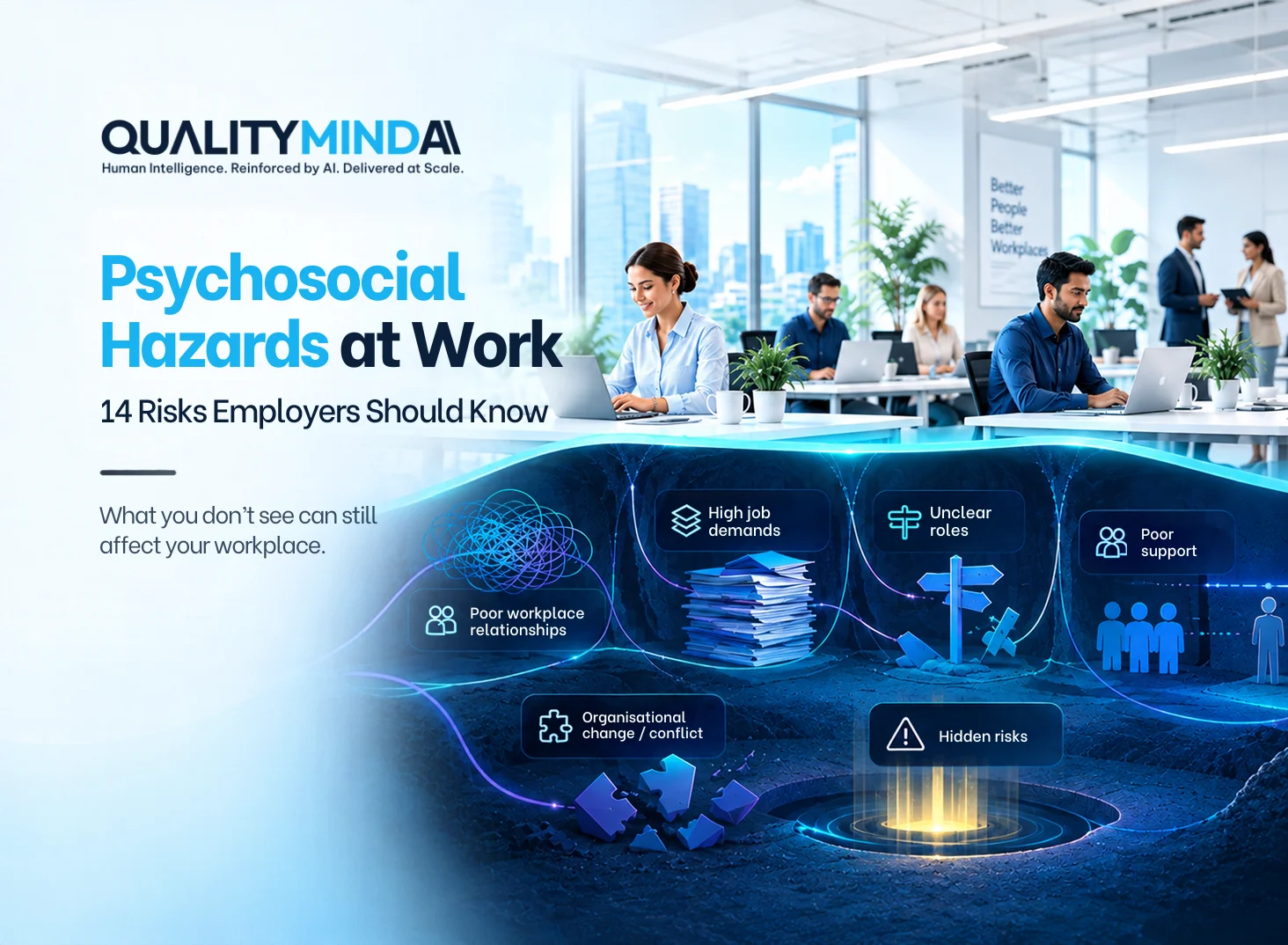
But not every workplace risk is visible.
An unreasonable workload can become a risk. So can bullying, poor management, unclear responsibilities or constant pressure to work without enough control over how the job gets done.
These are known as psychosocial hazards.
For Australian employers, understanding these hazards is becoming an increasingly important part of creating a safe and healthy workplace. Safe Work Australia defines psychosocial hazards as aspects of work that can cause psychological harm and, in some cases, physical harm as well.
The important thing is that psychosocial hazards aren’t limited to one type of workplace or one type of employee.
They can exist in an office, construction site, healthcare environment, retail business or remote workplace.
So, what should employers actually be looking for?
What are psychosocial hazards?
A psychosocial hazard is something about the design or management of work, the work environment, or workplace interactions that could cause psychological harm.
Importantly, having a hazard doesn’t automatically mean someone will be harmed.
The level of risk depends on factors such as how often, how long and how severely employees are exposed to it. Several hazards can also combine and increase the overall risk.
Here are the 14 common psychosocial hazards identified by Safe Work Australia.
- Job demands
- Low job control
- Poor support
- Lack of role clarity
- “Who’s responsible for this?”
- “Which deadline comes first?”
- “What exactly am I expected to deliver?”
- Poor organisational change management
- Inadequate reward and recognition
- Poor organisational justice
- Traumatic events or material
- Remote or isolated work
- Poor physical environment
- Violence and aggression
- Bullying
- Harassment
- Conflict or poor workplace relationships
Too much work, unrealistic deadlines, excessive emotional demands or long working hours can put employees under sustained pressure.
The problem isn’t simply having a busy day.
It is when high demands become persistent and employees don’t have enough time, resources or recovery to manage them effectively.
Employees generally need some level of control over how they perform their work.
When people have little say over their tasks, schedules, methods or decisions that directly affect their work, pressure can increase.
A lack of control can become particularly challenging when expectations remain high.
Employees need appropriate support from managers, supervisors and colleagues.
Poor support might mean not having someone to ask for help, inadequate resources, insufficient training or feeling unable to raise concerns.
Sometimes the issue isn’t that employees don’t want support. They simply don’t know where to get it.
When responsibilities, expectations or reporting lines aren’t clear, employees can spend as much energy trying to understand their role as they do performing it.
Clear responsibilities and expectations can remove a surprising amount of unnecessary workplace stress.
Change is part of modern business.
New systems, restructures, leadership changes and changes to responsibilities can all create uncertainty.
The risk increases when employees aren’t properly informed, consulted or supported through the change.
People don’t necessarily resist change itself. Often, they struggle with uncertainty around what the change means for them.
People want to feel that their work matters.
When effort, contribution or achievement consistently goes unnoticed, employees can become disengaged and frustrated.
Recognition doesn’t always mean financial rewards. Genuine acknowledgement, feedback and appreciation can also play an important role.
Employees notice when workplace decisions feel unfair.
This could involve inconsistent treatment, unfair allocation of work, biased decision-making or concerns being handled differently depending on who raises them.
A workplace doesn’t have to be perfectly equal in every situation, but employees should have confidence that decisions are made fairly and transparently.
Some employees may be exposed to traumatic situations as part of their work.
This can include witnessing serious injury, violence, abuse, death or other distressing events.
The risk can also come from repeated or indirect exposure, particularly in industries such as healthcare, emergency services, social services and community support.
Working remotely isn’t automatically a psychosocial hazard.
The risk can arise when employees are isolated, have limited access to support, or work in locations where communication and assistance are difficult.
For some workers, being physically separated from colleagues can also make it harder to recognise when they are struggling.
The physical workplace can affect psychological wellbeing too.
Excessive noise, poor lighting, uncomfortable temperatures, unsafe conditions or poorly maintained equipment can contribute to stress and fatigue.
Safe Work Australia notes that a poor physical environment can become a psychosocial hazard when conditions are severe, prolonged or frequent.
Employees who deal directly with customers, patients, clients or members of the public may be exposed to verbal threats, physical aggression or violence.
This isn’t simply a “difficult customer” issue.
Repeated or serious exposure can create significant psychological and physical risks.
Employers need to consider both prevention and how employees are supported after an incident.
Bullying can have a serious impact on psychological safety.
It may involve repeated unreasonable behaviour that creates a risk to a person’s health and safety.
It can be obvious, such as intimidation or humiliation, but it isn’t always easy to identify from the outside.
That’s why employees need safe ways to raise concerns without fear of further consequences.
Harassment includes behaviours that can humiliate, intimidate or otherwise cause harm.
This can include sexual harassment and gender-based harassment, as well as other forms of inappropriate conduct.
A workplace culture that ignores “small” incidents can allow harmful behaviour to become normalised.
Not every workplace disagreement is a psychosocial hazard.
People will naturally have different opinions and working styles.
The concern arises when conflict becomes persistent, hostile or damaging to workplace relationships.
Poor relationships between colleagues, managers and teams can create an environment where employees feel constantly tense or unsupported.
These hazards rarely exist on their own
One of the most important things employers need to understand is that psychosocial hazards can interact and combine.
For example, imagine a team with:
- increasing workloads
- unclear responsibilities
- little managerial support
- frequent organisational changes
Each issue is a concern on its own.
Together, they can create a much bigger problem.
An employee may eventually describe the result simply as:
“I’m overwhelmed.”
But the underlying problem isn’t necessarily the employee.
It may be the way work has been designed, managed and supported.
Safe Work Australia specifically recommends considering how psychosocial hazards interact, as combinations of hazards can increase risk.
What should Australian employers do?
The first step isn’t necessarily another wellbeing seminar.
It is identifying what’s actually happening in the workplace.
Employers should consult workers, understand where hazards exist, assess the level of risk and then work out what can reasonably be done to eliminate or minimise those risks.
- That could mean reviewing workloads.
- Clarifying responsibilities.
- Improving manager training.
- Changing processes.
- Strengthening reporting systems.
- Providing better resources.
- Or creating more accessible support for employees who are already experiencing pressure.
- The right solution depends on the hazard.
- A mindfulness session won’t fix an unreasonable workload.
- An EAP won’t fix chronic understaffing.
- And a new policy won’t automatically repair a culture where employees are afraid to speak up.
The control needs to address the cause.
Where employee wellbeing support fits in
This doesn’t mean employee wellbeing programs have no place.
They do.
Employees can benefit from having accessible support to help them manage stress, build resilience and develop healthier ways of responding to pressure.
But wellbeing support should complement—not replace—the employer’s responsibility to identify and manage workplace risks.
This distinction matters.
- If the underlying cause is excessive workload, the workload needs to be addressed.
- If the issue is bullying, the behaviour needs to be addressed.
- If employees lack role clarity, their roles need to be clarified.
At the same time, giving employees accessible support can help them navigate pressure while broader workplace improvements are being made.
That is where proactive approaches such as Quality Mind AI can complement an organisation’s wider psychosocial safety strategy by providing employees with accessible, ongoing support rather than relying only on support after problems have escalated.
The bigger question for employers
Psychosocial safety isn’t about creating a workplace where nobody ever feels stressed.
That’s unrealistic.
Work can be demanding. Deadlines happen. Change happens. Difficult conversations happen.
The goal is to make sure the way work is designed and managed doesn’t create unnecessary or unmanaged risks to people’s psychological health.
So instead of asking:
“Are our employees stressed?”
employers should ask:
“What is creating that stress, and what can we change?”
That shift moves the conversation from reacting to symptoms to addressing the workplace conditions behind them.
Final takeaway
- Psychosocial hazards aren’t always obvious.
- Sometimes they look like an overflowing inbox.
- Sometimes they’re an unclear job description.
- Sometimes they’re a manager who doesn’t listen.
- Sometimes they’re constant change, isolation, bullying or simply too much work for too few people.
- Recognising these risks is the first step.
- Managing them is what makes the difference.
- For Australian employers, psychosocial safety should be treated as part of workplace safety—not as an optional extra added to the wellbeing calendar.
- Because a healthy workplace isn’t just one where people are protected from physical harm.
It’s one where people can do their work without being placed under unnecessary psychological risk.