AI is now being used for everything from writing emails to analysing data. So it was probably only a matter of time before it entered the world of coaching.
But that raises a reasonable question:
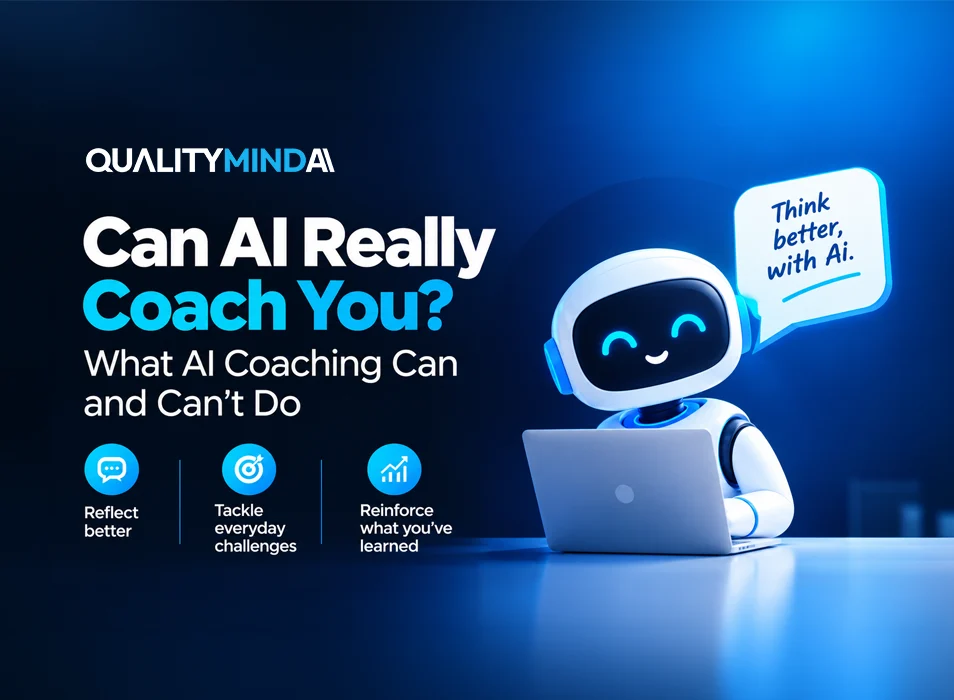
Can AI really coach someone?
Coaching has traditionally involved a person talking with another person, asking questions, exploring challenges and working towards practical changes. AI obviously can’t replicate every part of that relationship.
But it can provide a different type of support.
The useful question isn’t whether AI can completely replace a human coach. It is where AI coaching can be useful, where it has limitations, and how it can complement existing support.
What is AI coaching?
AI coaching uses artificial intelligence to have structured conversations with a person and provide questions, prompts, reflections or practical suggestions based on what they share.
Unlike traditional coaching, it doesn’t require an appointment.
Someone might use it after a difficult conversation at work, when they’re struggling with a particular thought, or when they simply want to think through a situation before deciding what to do.
This accessibility is one of the main reasons AI coaching is gaining attention.
People don’t always need support at 10 a.m. on a Tuesday when they have a scheduled appointment.
Sometimes they need a chance to reflect at 8 p.m. after a difficult day.
That’s the kind of gap AI coaching can help address.
What can AI coaching actually help with?
Helping people reflect
One useful role for AI coaching is simply helping someone slow down and think about a situation.
For example, an employee might be frustrated after receiving difficult feedback from their manager.
Instead of immediately reacting, they could use an AI coach to explore questions such as:
- What specifically happened?
- What part of the situation is bothering you?
- What assumptions are you making?
- What response would be most useful?
The AI isn’t making the decision for them.
It is helping them look at the situation from another angle.
Supporting everyday challenges
AI coaching can also be useful for relatively common challenges.
That might include managing workplace pressure, preparing for a difficult conversation, thinking through priorities or trying to establish healthier habits.
These are situations where someone may benefit from having an opportunity to pause and organise their thoughts.
It doesn’t mean every problem needs coaching.
It simply gives people another option when they want some guidance or structured reflection.
Reinforcing what people have already learned
Another challenge with coaching and wellbeing education is that learning something once doesn’t necessarily mean it becomes a habit.
An employee might attend a workshop on managing stress and understand the techniques perfectly well. A few weeks later, they may still fall back into their usual patterns when work becomes busy.
This is where repetition can be useful.
Quality Mind AI’s Neuro-Repetition™ methodology focuses on revisiting and reinforcing mindset and behavioural frameworks over time.
The idea is fairly straightforward: rather than treating development as a single conversation or learning experience, people have opportunities to return to the concepts and practise applying them in different situations.
What AI coaching can’t do
This is just as important as understanding what it can do.
AI coaching has limitations, and responsible use means being clear about them.
It isn’t the same as a human coach
A human coach brings experience, judgement and the ability to understand a person within the broader context of their life and circumstances.
AI works differently.
It responds to the information provided during the interaction. It doesn’t have personal experience or the same depth of human understanding.
For some situations, that difference matters.
Complex leadership challenges, sensitive workplace relationships or situations requiring nuanced professional judgement may benefit more from working with an experienced human coach.
It isn’t therapy
AI coaching should also not be confused with psychological treatment.
Someone experiencing significant mental health difficulties may require assessment or treatment from a qualified professional.
Quality Mind AI makes this distinction clear. Its service is positioned as coaching and mentoring rather than a replacement for clinical or psychological care.
That boundary is important.
The purpose of AI coaching is not to make every form of professional support unnecessary.
So, is AI coaching actually useful?
It can be.
But its usefulness depends on what you expect it to do.
If someone expects an AI coach to understand them exactly like a human coach would, they may be disappointed.
If they see it as an accessible tool for reflection, guidance and reinforcement, there is a more realistic use case.
Consider the difference between these two expectations:
“AI will solve my problems.”
and
“AI can help me think through my problems.”
The second is much closer to what AI coaching can realistically offer.
Where Quality Mind AI fits
Quality Mind AI uses AI coaching as part of a broader approach to employee wellbeing and mental performance.
Its platform provides private voice and text conversations that employees can access when they want support or a chance to work through a particular situation.
The focus isn’t simply on answering questions.
Quality Mind AI also uses its Neuro-Repetition™ methodology to reinforce selected mindset and behavioural frameworks over time.
This is particularly relevant in a workplace setting because challenges don’t happen only during scheduled coaching sessions.
An employee may have a difficult interaction with a colleague in the afternoon, feel overwhelmed by competing priorities later that day, or find themselves thinking about work after hours.
Having an accessible support option means they can address the situation closer to when it happens.
For organisations, this can sit alongside existing support such as EAPs, human coaching and professional mental health services.
It doesn’t have to replace them.
AI coaching works best as part of a wider support system
There is a temptation to look at AI as either the solution or the problem.
The reality is more practical.
Different types of support serve different purposes.
An EAP can provide access to professional services.
A human coach can provide personalised coaching and deeper context.
A manager can provide support within the workplace.
An AI coach can provide accessible, ongoing opportunities for reflection and reinforcement.
Used appropriately, these approaches don’t necessarily compete with each other.
They can complement one another.
The question employers should be asking
For organisations considering AI coaching, the question shouldn’t simply be:
“Can AI replace coaching?”
A better question is:
“Where could AI make support easier to access?”
That might be between coaching sessions.
It might be outside normal working hours.
It might be for employees who aren’t ready to speak to someone directly but want to start by reflecting on what’s happening.
Or it might simply provide another way for employees to revisit and practise ideas they’ve already learned.
Those are more realistic and useful applications of the technology.
The bottom line
So, can AI really coach you?
To an extent, yes—but it has a different role from a human coach.
AI can help people reflect, explore everyday challenges and reinforce useful behavioural patterns. It can also make certain types of support available without requiring a scheduled appointment.
But it doesn’t replace human judgement, professional mental health care or genuine human relationships.
Quality Mind AI takes a similar approach by using AI coaching alongside its Neuro-Repetition™ methodology and human coaching options, rather than presenting AI as a replacement for every other
form of support.
The value isn’t in making AI do everything.
It’s in using it where it can genuinely be useful.