Most organisations today have some form of employee wellbeing support. Many offer an Employee Assistance Program (EAP), counselling services, mental health resources, or wellbeing initiatives.
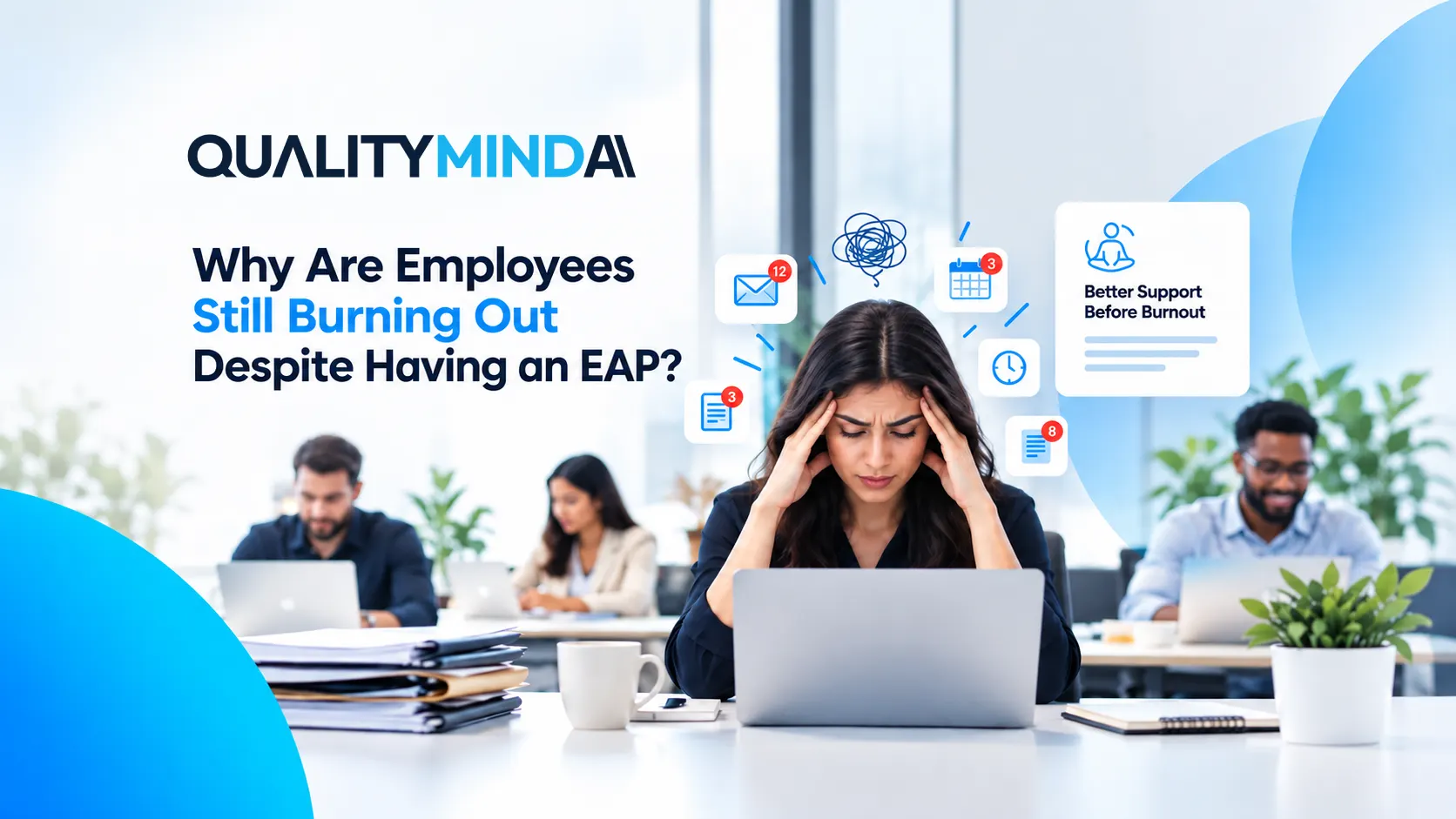
So why are employees still burning out?
It is a question worth asking.
An EAP can be a valuable safety net, but it is usually designed to help when an employee recognises that they need support and decides to reach out. Burnout, however, often develops much earlier-quietly, gradually, and sometimes without the employee even realising what is happening.
That is where the gap begins.
An EAP helps when someone asks for help
An EAP gives employees somewhere to turn when they are struggling. They can access confidential support, counselling, or other professional services.
The challenge is that many employees don’t reach that point early.
Someone may be feeling constantly tired, struggling to concentrate, becoming increasingly frustrated, or finding it difficult to switch off after work. But instead of thinking, “I should contact the EAP,” they may simply think:
- “It’s just a busy period.”
- “Things will settle down next week.”
- “Everyone is under pressure.”
And so they keep going.
By the time they actively look for support, the stress may have been building for weeks or months.
This doesn’t make the EAP ineffective. It highlights its role.
An EAP is often reactive, while burnout prevention needs to be proactive.
Burnout doesn’t usually happen overnight
Burnout is rarely caused by one difficult day.
It is more often the result of ongoing pressure without enough opportunity to recover.
- A heavy workload becomes normal.
- Late nights become normal.
- Skipping breaks becomes normal.
- Constant notifications become normal.
- Feeling mentally exhausted becomes normal.
Eventually, an employee may not even recognise these behaviours as warning signs.
This is why an annual wellbeing presentation or an occasional reminder about the EAP may not be enough.
People don’t necessarily need more information. They need opportunities to apply what they know in their everyday lives.
Knowing how to manage stress and actually managing it when you’re under pressure are two very different things.
The missing piece: support between the big moments
- Think about when workplace stress actually happens.
- It might be five minutes before an important meeting.
- After receiving difficult feedback.
- When several deadlines suddenly collide.
- Late at night when work is still running through someone’s mind.
- Those moments don’t necessarily happen during an EAP appointment.
- This is where more accessible, everyday support can complement traditional employee assistance.
- Instead of waiting for someone to book a session, employees can have access to tools and guidance when they actually need them.
Quality Mind AI takes this approach through its always-on digital support, giving employees access to private voice and text-based conversations whenever they need them.
The idea isn’t to replace professional support.
It’s to make support easier to access before everyday stress becomes something much bigger.
One-off wellbeing initiatives have another problem: people forget
Even the best wellbeing advice can disappear surprisingly quickly.
An employee might attend a great workshop about managing stress. They learn useful techniques and leave feeling motivated.
- Then Monday arrives.
- The inbox fills up.
- A difficult meeting happens.
- A deadline moves forward.
- And the techniques they learned become another thing they intended to practise but never quite got around to.
This is why repetition matters.
Quality Mind AI’s Neuro-Repetition™ methodology is built around reinforcing useful mindset and behavioural patterns over time rather than relying entirely on one-off learning experiences.
The principle is simple: learning something once doesn’t necessarily change behaviour. Repeated reinforcement can help make a new response more familiar and easier to use.
That can be particularly relevant when employees are dealing with recurring workplace pressure.
There is also the issue of stigma
Even when employees know an EAP is confidential, some may still hesitate to use it.
- They might worry about being judged.
- They may feel that asking for help means they aren’t coping.
- Or they may simply not want to have a formal conversation about what they’re experiencing.
- For someone already feeling overwhelmed, taking the first step can feel surprisingly difficult.
- Making support private, simple, and easy to access can remove some of that friction.
- It also allows employees to engage with support earlier, rather than waiting until their situation feels serious enough to justify asking for help.
So, should organisations replace their EAP?
No.
The better question is whether the EAP should be the only layer of employee wellbeing support.
- An effective wellbeing strategy can have different levels.
- An EAP can provide professional support when employees need it.
- Managers can play an important role in recognising concerns and creating healthier team environments.
And proactive, everyday tools can help employees build better ways of managing pressure before they reach a crisis point.
These approaches can work alongside each other.
The goal isn’t to choose between human support and technology.
It is to make sure employees have the right kind of support at the right time.
Moving from reactive to proactive wellbeing
For organisations, the conversation around employee wellbeing is changing.
It is no longer enough to ask:
“Do we have an EAP?”
A better question is:
“What support does an employee have before they reach the point where they need an EAP?”
That shift is important.
Because preventing burnout isn’t simply about responding when someone is already struggling. It is also about helping people recognise pressure earlier, develop healthier responses, and access support without unnecessary barriers.
An EAP can remain an important part of that picture.
But it shouldn’t have to carry the whole picture.
The bottom line
Employees can still burn out despite having an EAP because access to support isn’t the same as proactive support.
An EAP provides an important safety net, but organisations also need to think about what happens in the days and weeks before an employee reaches for it.
That is where accessible, consistent and preventative wellbeing support can make a difference.
The goal isn’t to wait until employees are at breaking point.
It’s to support them well before they get there.
Quality Mind AI is designed around this proactive approach, combining always-on digital support with its Neuro-Repetition™ methodology to help employees build and reinforce healthier patterns over time.